Step It Up: Transform Your Staircase with Paint
Add personality and visual interest to one of your home's most overlooked features
Your staircase doesn't have to be merely functional—it can be a stunning design feature that sets the tone for your entire home. With some paint and creativity, you can transform this high-traffic area into a visual focal point without the cost of a major renovation. From subtle two-tone treatments to bold geometric patterns, painted stairs offer endless possibilities for personalizing your space and adding unexpected color in a typically overlooked area.
Materials & Supplies
| • Cleaning Supplies: TSP cleaner, sponges, rags |
| • Prep Materials: Sandpaper (120 & 220 grit), putty knife |
| • Repair Supplies: Wood filler, caulk for gaps |
| • Primers: Stain-blocking primer, bonding primer |
| • Paints: Floor/porch paint or enamel for treads |
| • For Risers: Interior paint in desired finish |
| • Tools: Quality brushes, small rollers, painter's tape |
| • Safety: Non-slip additive for tread paint |
| • Protective Finish: Clear polyurethane for high traffic |
Painting Process
- Plan your design. Decide whether you'll paint just the risers, just the treads, or both. Consider patterns, color gradients, or stencil designs for risers. For a traditional look, paint treads dark and risers white or a light color.
- Prepare your workspace. Remove any carpet or coverings and thoroughly clean the stairs with TSP to remove grease and dirt. Plan for alternate access if possible, as stairs will be unusable during the project.
- Repair and prep surfaces. Fill holes or cracks with wood filler and sand smooth. For worn treads, consider more extensive repairs before painting. Sand all surfaces lightly for better paint adhesion.
- Apply painter's tape. Carefully tape off areas to create clean lines between risers and treads. For patterned designs, create templates or use painter's tape to mark patterns.
- Prime all surfaces. Apply a bonding primer to ensure paint adheres well to existing finishes. For previously stained wood, use a stain-blocking primer to prevent bleed-through.
- Paint strategically. Work from top to bottom, painting every other step to maintain access. Paint risers first, then allow ample drying time before painting treads. For treads, consider a floor or porch paint designed for durability.
- Add safety features. Mix a non-slip additive into the final coat of paint for treads to prevent slippery surfaces, especially important for homes with children or elderly residents.
- Apply protective finish. Once all paint is thoroughly dry (at least 24-48 hours), apply 2-3 coats of clear polyurethane to treads for extra durability and protection against scuffs and wear.
- Allow proper curing time. Though dry to the touch within hours, newly painted stairs need several days to fully cure. Wait at least 24 hours before light use, and avoid heavy traffic for 3-5 days.
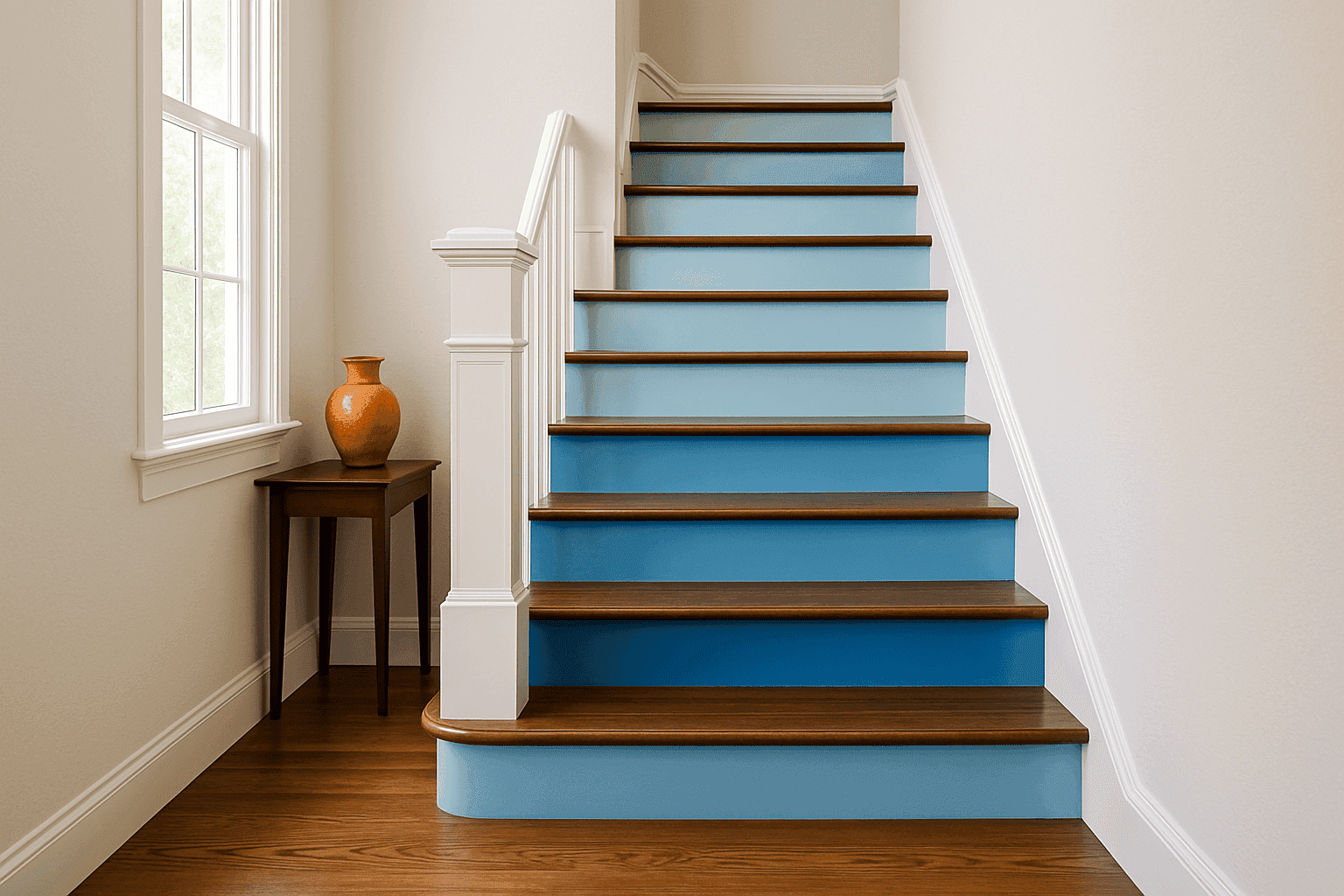
For a subtly elegant approach that won't overwhelm your space, consider an ombré effect on your risers—transitioning gradually from dark at the bottom to light at the top, or coordinating with wall colors on different levels of your home. If you're hesitant to commit to a bold pattern, try painting just the outer edge of each tread in an accent color that complements your decor. This creates a custom look that's noticeable but not overwhelming. For maximum durability in high-traffic homes, remember that darker colors and satin or semi-gloss finishes hide scuffs better than lighter colors or matte finishes.