20-Minute Win: Declutter One Kitchen Cabinet
Start with your most chaotic cabinet — the one that avalanches when you open it — and transform your whole kitchen in just 20 minutes
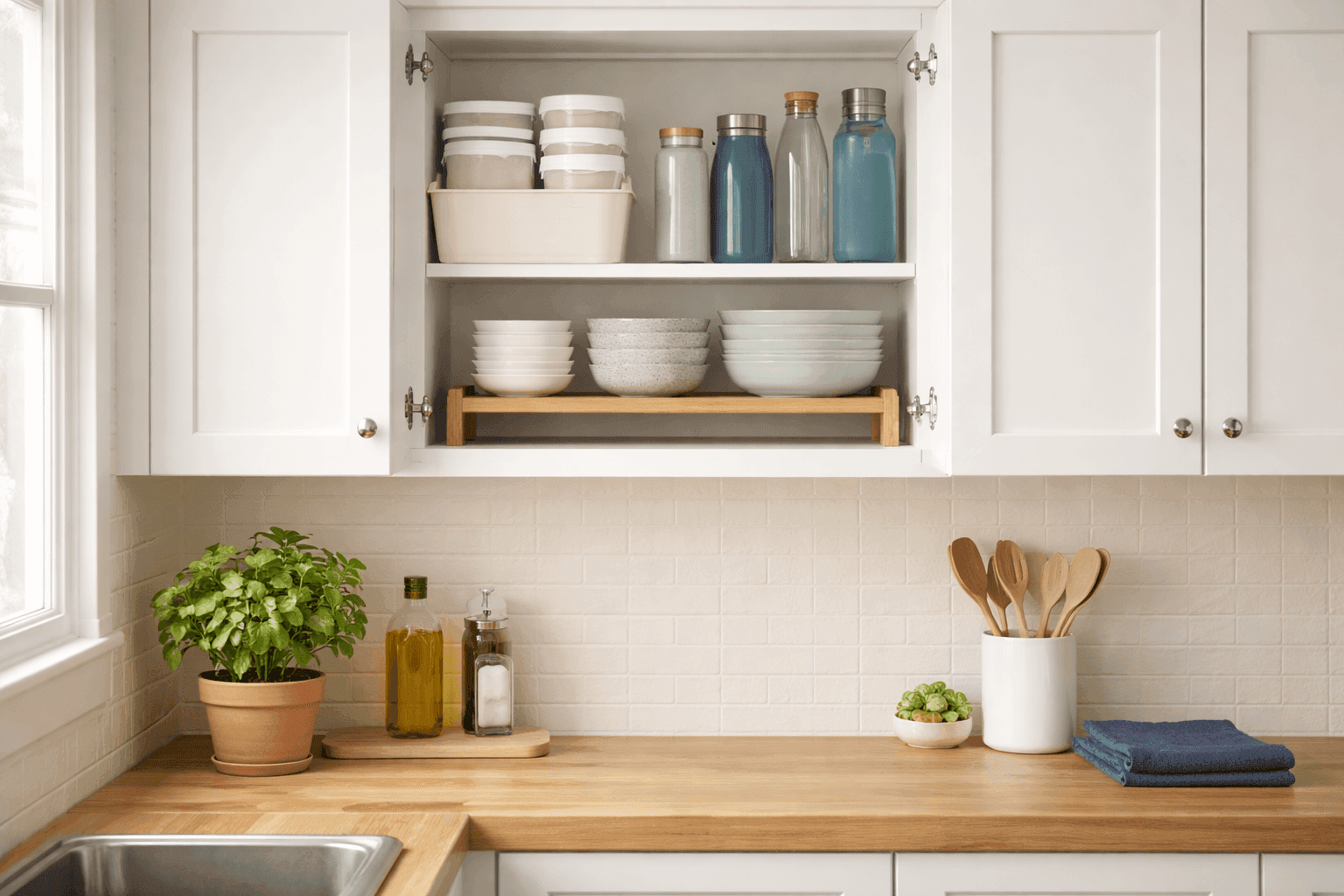
You know the cabinet. The one you open with one hand braced against whatever's about to fall out, the one where lids and containers have been breeding in the dark for years, the one you close as fast as possible and pretend doesn't exist. Every kitchen has one, and the reason it never gets fixed isn't laziness — it's that the whole project feels bigger than it actually is. Twenty minutes. That's genuinely all this takes, and the payoff is completely out of proportion to the effort. An organized cabinet doesn't just look better — it makes cooking less stressful, reduces the low-level daily frustration of hunting for matching lids, and almost always inspires you to tackle the next one. This Sunday Spruce-Up is about picking one small battle, winning it completely, and letting that momentum do the rest of the work for you.
What You'll Need
- Cleaning Supplies
- All-purpose cleaner or white vinegar solution in a spray bottle
- Clean microfiber cloth or paper towels for wiping shelves
- Optional: shelf liner cut to size for a fresh, clean base layer — ~$6–$10 for a roll that covers multiple shelves
- Sorting System
- Three boxes or bags labeled Keep, Donate, and Toss — repurpose grocery bags or cardboard boxes you already have
- A timer set to 20 minutes — this keeps decision fatigue from derailing the whole project into a two-hour spiral
- Organization Tools (Optional but Helpful)
- Shelf risers to double vertical storage space — ~$8–$15 for a set, or DIY with a cut piece of 1x4 board
- Small wire or plastic bins for corralling like items — dollar store bins work perfectly here
- A magazine holder or small upright bin for storing container lids vertically — ~$3–$6
- Lazy Susan turntable for deep corner cabinets where things disappear into the back — ~$8–$12
- Adhesive hooks or a small tension rod for hanging lightweight items inside the door
- Labels (Optional)
- Masking tape and a marker for simple bin labels that take 10 seconds each
- OR a label maker if you're the kind of person who already owns one and knows it
How to Do It
- Choose your cabinet strategically — pick the one that causes you the most daily frustration rather than the easiest one, because fixing the worst offender first gives you the biggest immediate quality-of-life payoff and the most motivation to keep going. Set your timer for 20 minutes before you touch a single thing so time pressure keeps decisions moving instead of stalling.
- Empty everything completely onto the counter or kitchen table — every single item, no exceptions, no "I'll just leave this one thing in there." A fully empty cabinet gets properly wiped down, properly assessed, and properly reorganized in a way that pulling things out one at a time never achieves. Spray and wipe the shelves while everything is out and let them air dry for two minutes before anything goes back in.
- Sort ruthlessly into your three categories — Keep, Donate, and Toss — making fast decisions without overthinking. The rule of thumb that actually works: if you haven't reached for it in six months and you can't name a specific upcoming occasion when you will, it goes in Donate or Toss. Mystery-stained containers, warped lids, duplicate gadgets, and expired food items go straight to Toss without negotiation.
- Match lids to containers before anything goes back into the cabinet — this is the step that takes three minutes and saves three minutes of frustration every single day. Any container without a matching lid and any lid without a matching container gets tossed immediately, no exceptions, because an unmatched lid is just clutter that has convinced you it might be useful someday.
- Group like items together into categories that reflect how you actually cook — all food storage containers together, all water bottles together, all baking dishes stacked by size, all small appliance accessories in one spot. The categories that make sense are the ones based on your actual habits, not some organizational system you read about, so trust your instincts about what naturally belongs near what.
- Maximize the vertical space by placing shelf risers or a small wire rack on the shelf to create two tiers of storage in the same footprint — this single step often doubles the usable space in a cabinet and is the reason organized cabinets can hold more than chaotic ones even when the total volume is identical. Store lids vertically in a small bin or magazine holder so they're visible and accessible rather than buried in a flat stack.
- Return items strategically by placing the things you reach for daily at the front and at eye level, and less-used items toward the back and on higher or lower shelves. This sounds obvious but most cabinets are organized by what fits where rather than what gets used when — reversing that logic is what makes a cabinet feel genuinely functional rather than just tidier than before.
- Take one minute to admire it before moving on — open and close the cabinet a few times, notice that nothing avalanches, register how different it feels to find what you're looking for immediately. This isn't vanity, it's reinforcement that makes it far more likely you'll maintain the organization and tackle the next cabinet next Sunday instead of letting everything drift back to chaos within a week.
Professional organizers have a term for the real reason kitchen cabinets descend back into chaos within weeks of being organized: the system wasn't designed for how the cabinet actually gets used. The single most effective thing you can do to make organization stick is add friction to putting things away wrong and remove friction from putting things away right. That means bins and zones that are obvious enough that anyone in the household can return things correctly without thinking about it — no complicated folding methods, no intricate stacking sequences, no systems that require labeling every individual item. A simple vertical lid holder takes three seconds to use correctly every time; a flat lid stack takes three seconds to destroy every time someone grabs one from the bottom. Design for your laziest, most rushed moment in the kitchen, and the organization will actually last.