Fix a Sticky Deadbolt in 15 Minutes for Free
Graphite lubricant, a screwdriver, and fifteen minutes — the deadbolt that requires two hands and a prayer turns smoothly before dinner
A deadbolt that requires excessive force to turn is one of those household problems that sits at the precise intersection of daily frustration and genuine security risk — awkward enough that you dread unlocking your own front door, serious enough that a lock you're wrestling with in the dark or under stress is a lock that could fail you when it matters most. The fix is almost always one of three things: a mechanism that needs lubrication, a strike plate that has drifted out of alignment, or mounting screws that have been overtightened to the point of binding the internal components — and all three are resolvable in fifteen minutes with a tube of graphite lubricant and a Phillips screwdriver. No locksmith, no replacement hardware, no prior knowledge required. A deadbolt that turns with a single finger is not a luxury — it is what a properly functioning lock feels like, and getting yours there costs nothing beyond the time it takes to do it.
What You Need
- Graphite lubricant spray or powder — not WD-40, which is a solvent and moisture displacer rather than a true lubricant; WD-40 flushes existing lubrication from lock mechanisms and leaves a residue that attracts and holds the dust and debris that causes sticking in the first place (~$4–6 for a tube of graphite lubricant that lasts for years of lock maintenance)
- Phillips screwdriver — for removing the two interior mounting screws if full mechanism access is needed, and for adjusting strike plate position
- Flathead screwdriver — for adjusting strike plate screws on older installations and for prying the strike plate slightly during repositioning
- Flashlight or phone torch — for examining the bolt-to-strike-plate alignment clearly with the door closed, and for inspecting the keyhole interior condition
- Your key — for working lubricant through the mechanism after application and for testing smooth operation at each stage of the repair
- Chisel and hammer — optional, for deepening or widening the strike plate mortise in the door frame if the plate needs repositioning beyond what the existing screw holes allow (~$8–12 if you don't already own one)
How to Fix It
- Start with the simplest possible intervention before removing anything — spray graphite lubricant directly into the keyhole with the thin applicator tube, applying two to three short bursts that reach the pin tumblers inside the cylinder. Insert your key and work it in and out of the keyhole ten to fifteen times, turning it through the full lock and unlock cycle each time to distribute the lubricant through every moving surface in the cylinder. Test the lock; a mechanism that was sticking purely from dried-out lubrication will often turn smoothly after this step alone.
- Check bolt-to-strike-plate alignment if lubrication alone doesn't resolve the sticking — close the door fully and extend the deadbolt slowly while watching through the gap between the door edge and the frame. The bolt should slide smoothly and directly into the strike plate hole without contacting the plate face, the hole edges, or the surrounding frame. A bolt that visibly scrapes the top, bottom, or side of the strike plate opening is binding against that surface every time the lock is operated, which no amount of lubrication will resolve.
- Mark the correct strike plate position if adjustment is needed by applying a small amount of lipstick or chalk to the bolt tip, extending the bolt, closing the door, and retracting the bolt — the transfer mark on the strike plate face shows you exactly where the bolt is currently contacting and which direction the plate needs to move for the bolt to enter the hole cleanly.
- Adjust the strike plate by loosening its mounting screws until the plate can be shifted in the direction your transfer mark indicates is needed — typically a matter of one to three millimeters in any direction. Reposition, retighten the screws firmly, and test the bolt operation with the door closed before considering the alignment correction complete. A strike plate shifted even one millimeter in the correct direction can transform a lock that required significant force into one that operates with a single finger.
- Deepen the strike plate mortise with a sharp chisel if the plate needs more repositioning than the existing screw holes allow — score the new mortise boundary with the chisel tip, then remove material in thin passes working with the wood grain rather than against it. This is the most involved step in any deadbolt adjustment and the one most people are most hesitant about, but a sharp chisel and patient work produces a clean mortise that seats the repositioned plate perfectly flush with the door frame surface.
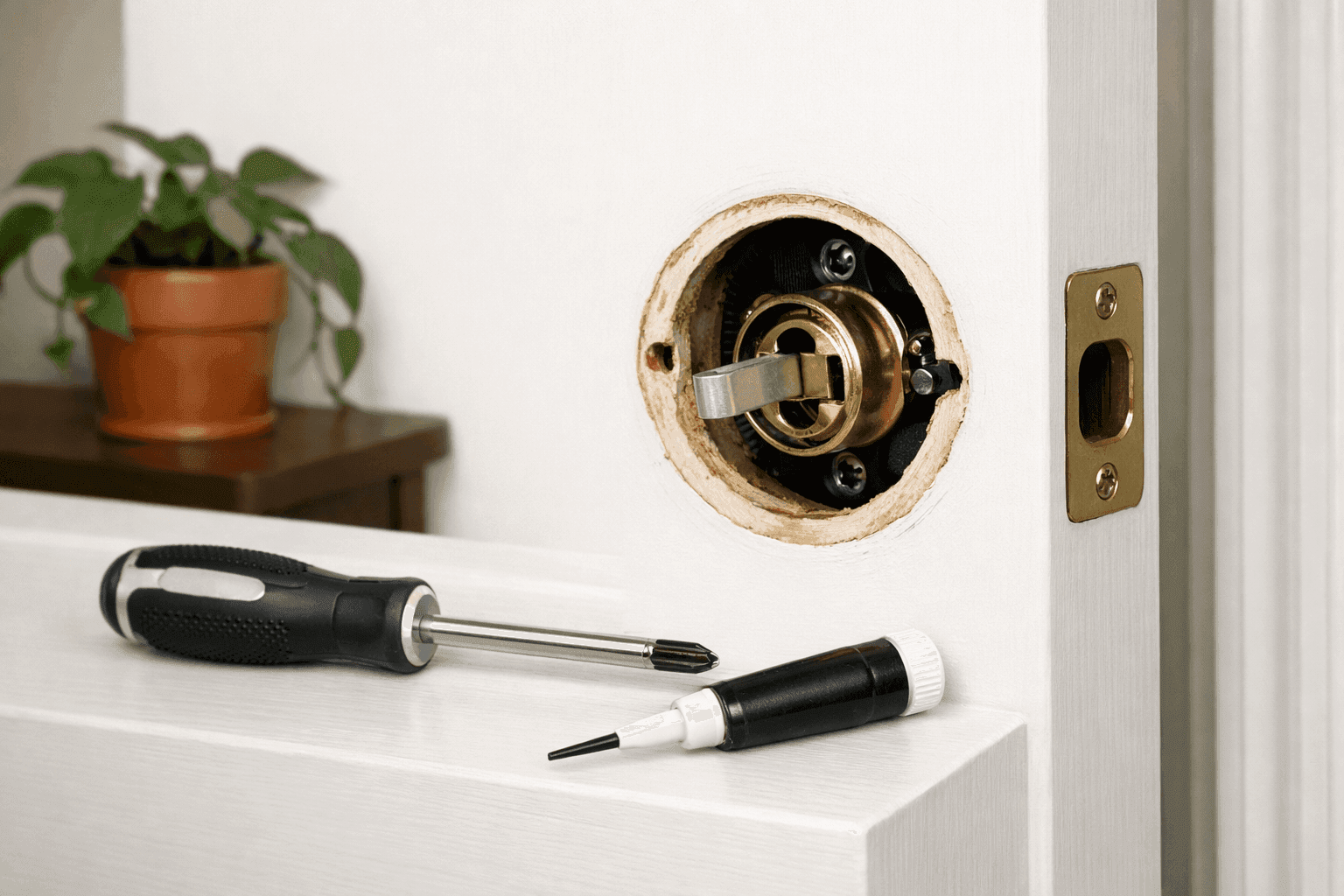
- Remove the entire deadbolt assembly for deeper lubrication if the mechanism still sticks after keyhole lubrication and alignment correction — locate the two Phillips screws on the interior face of the door that pass through the rose plate and thread into the exterior cylinder body, and remove them completely. Separate the interior and exterior halves of the lock from each other and from the door, noting how the connecting bar between them is oriented before disassembly so reassembly is straightforward.
- Lubricate all accessible moving surfaces of the disassembled mechanism with graphite spray, working the bolt and cam components through their full range of motion by hand while applying lubricant to ensure every bearing surface receives coverage. Pay particular attention to the bolt itself and the housing channel it travels through — this is the surface most likely to be dry and corroded on a lock that has been sticking for an extended period.
- Reinstall the deadbolt by reversing the disassembly sequence, being careful not to overtighten the two mounting screws — snug is correct, and firmly tight is too far. Overtightened mounting screws compress the lock body against the door face and bind the internal components in exactly the same way that misalignment does, which is why a lock that was smooth before removal sometimes sticks immediately after reinstallation. Drive the screws until resistance is felt, then back off a quarter turn and test the mechanism before considering installation complete.
Licensed locksmiths who service residential deadbolts always check door hinge condition and frame squareness before diagnosing a sticking lock — a door that has sagged on its hinges or a frame that has racked slightly out of square due to foundation settlement creates a bolt-to-strike misalignment that reappears within weeks of any strike plate adjustment because the underlying door position is continuing to shift. The quick test is to check whether the door closes with the same resistance and gap consistency at the top and bottom corners; a door that binds at the top and gaps at the bottom is sagging at the hinge side, and tightening the hinge screws — or replacing stripped hinge screws with longer ones that reach fresh wood — often resolves a chronic deadbolt sticking problem that repeated strike plate adjustments have failed to fix permanently.