Install a Rain Barrel System in 3 Hours for $75
Capture free water from every storm and give your plants exactly what they prefer
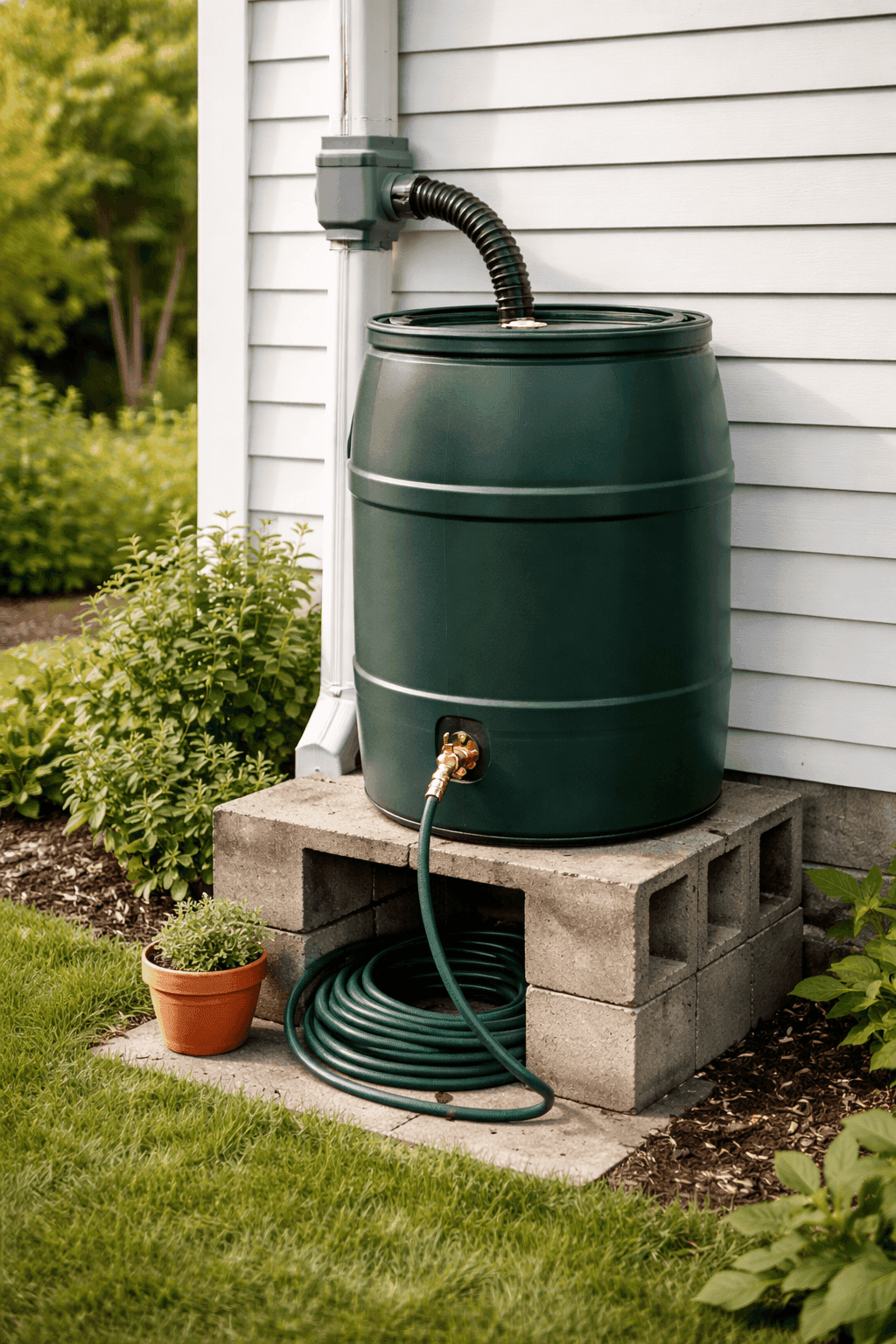
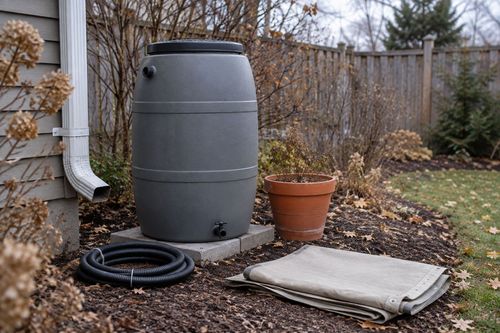
Every time it rains, your roof collects hundreds of gallons of water and funnels it straight down the downspout and into the storm drain — water that your garden would have loved, completely free of the chlorine and fluoride that come out of the tap and that plants merely tolerate rather than thrive in. A rain barrel system intercepts that runoff at the downspout, stores it in a 55-gallon barrel, and makes it available to your garden through a standard spigot whenever you need it. The setup takes two to three hours, costs $50–100 depending on whether you buy a purpose-built barrel or convert a food-grade drum yourself, and pays back in lower water bills from the first dry stretch of summer. A single moderate rainfall on a typical suburban roof can fill the barrel completely, meaning one storm can cover a week of garden watering without turning on the tap once. This is one of those projects where the environmental payoff, the plant health benefit, and the money savings all point in exactly the same direction — which is a rare and satisfying thing.
What You'll Need
- The Barrel (choose one)
- Purpose-built rain barrel with built-in spigot, overflow port, and mesh screen lid — the easiest option with the least modification required (~$50–90 at home improvement stores or online)
- 55-gallon food-grade plastic drum — the DIY conversion route that often runs $15–30 from local food suppliers, car washes, or Craigslist; requires adding your own spigot, overflow fitting, and screen cover
- Look for barrels that previously held food-safe liquids like juice concentrate, olives, or soap — avoid any drum that held chemicals or petroleum products regardless of how thoroughly it was cleaned
- Downspout Connection
- Downspout diverter kit — a purpose-built fitting that installs into your existing downspout, redirects water into the barrel when it's filling, and automatically bypasses back to the downspout once the barrel is full (~$15–25); this is strongly preferred over simply cutting the downspout and directing it into an open barrel
- Flexible downspout extension or corrugated drainage hose to connect the diverter to the barrel inlet (~$5–10 for a 4-foot section)
- The Platform
- Cinder blocks, concrete pavers, or a purpose-built barrel stand to elevate the barrel 12–18 inches off the ground — elevation creates the water pressure needed to fill a watering can or run a hose by gravity alone
- A full 55-gallon barrel weighs approximately 460 pounds, so the platform must be level, stable, and placed on firm compacted ground — never on soft soil or mulch
- For DIY Barrel Conversion
- 3/4-inch brass spigot with rubber washers and hose thread for connecting a garden hose (~$8–12)
- 1-inch bulkhead fitting for the overflow port near the top of the barrel (~$5–8)
- Fine mesh window screen material and a bungee cord or zip ties to cover the barrel opening and keep out mosquitoes and debris
- Hole saw or spade bit sized to your fittings, plus plumber's thread tape
- Total Cost
- $50–100 for a purpose-built barrel with diverter kit and platform materials; $30–55 for the DIY drum conversion route
How to Install It
- Check local regulations before buying anything — rainwater collection is legal in most U.S. states but a small number have restrictions or permit requirements, particularly in western states where water rights laws are more complex. A quick search for "[your state] rain barrel laws" takes two minutes and prevents a frustrating surprise after the install is complete.
- Choose your downspout location by identifying which downspout is closest to the area of your garden that needs watering most often — this is usually a back or side downspout near garden beds rather than a front corner. Confirm the ground at that location is level and firm enough to support a 460-pound loaded barrel on its platform before committing to the spot.
- Build the platform by stacking cinder blocks or pavers at least 12 inches high on firmly compacted ground, checking level in both directions before placing anything on top. Taller is better for gravity pressure — every inch of elevation above the spigot adds a small but meaningful increase in flow rate, so 18 inches is worth the extra block if your ground is stable enough to support it.
- Install the spigot and overflow port if working with a DIY drum — drill the spigot hole about 3 inches from the bottom of the barrel (low enough to access nearly all the stored water, high enough to fit a watering can underneath), and the overflow hole near the top on the opposite side. Wrap all fittings with plumber's thread tape before threading in, and hand-tighten plus one full turn with pliers — overtightening cracks plastic barrels.
- Cover the barrel opening with fine mesh screen secured tightly around the rim — this step is non-negotiable for any open-top barrel. Standing water is prime mosquito breeding habitat, and an uncovered barrel can produce a new generation of mosquitoes within a week during warm weather. Purpose-built barrels include a screened lid; DIY conversions need a secured screen layer before the barrel receives a single drop of water.
- Install the downspout diverter by measuring the height of your barrel inlet and marking the corresponding cut point on the downspout — the diverter will replace a section of downspout at that height. Use a hacksaw to cut out the marked section, snap the diverter fitting into place, and connect the flexible extension hose from the diverter outlet to the barrel inlet. Most diverter kits include clear instructions and take about 20 minutes to install cleanly.
- Direct the overflow away from the house foundation before calling the install complete — connect a short length of corrugated drainage hose to the overflow port and route it at least 6 feet away from the foundation, ideally toward a garden bed or a low spot in the yard. An overflow that drains toward the house is worse than no rain barrel at all during a heavy storm when the barrel fills in minutes.
- Test the full system with a garden hose run into the barrel inlet before the first rain — fill the barrel partially, open the spigot, and confirm water flows freely; check all fittings for drips; verify the overflow exits correctly; and confirm the platform remains stable under partial load. Fixing a small fitting drip before 460 pounds of water is sitting on the platform is considerably easier than fixing it after.
Permaculture designers and serious water-harvesting gardeners almost always link multiple rain barrels in series rather than stopping at one — a second barrel connected to the overflow port of the first doubles your storage capacity for the cost of one additional barrel and a short length of hose, with no additional downspout work required. The connection is as simple as running a hose from the overflow of barrel one into the inlet of barrel two positioned at the same or slightly lower elevation beside it. Two linked 55-gallon barrels capture 110 gallons per storm, which covers a full week of garden watering for most suburban plots during a dry stretch — and the second barrel investment pays back just as quickly as the first.