Style a Fall Bookshelf Refresh in 2 Hours for $40
The difference between a bookshelf that looks curated and one that looks cluttered comes down to negative space, not how many pretty objects you own.
![[#~image_alt_1~#]](/_next/image?url=https%3A%2F%2Fd3klpa3rfwubzz.cloudfront.net%2Fmedia%2FAPI%20Uploads%2FDIY%2Fe67c34319bc979ef2a40e5d87270cd96_f11b978a97.jpg&w=1920&q=75)
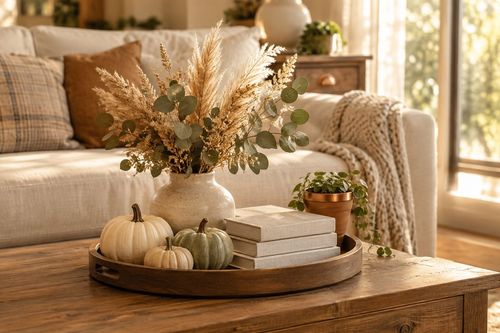
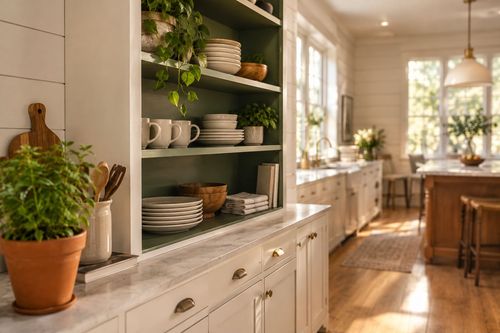
Most bookshelves fail the same way: every shelf gets filled edge to edge, so the eye has nowhere to rest and the whole thing reads as clutter instead of decor. The mechanism that actually fixes this is negative space paired with visual triangles — grouping objects in odd numbers at varying heights while leaving roughly 20-30% of each shelf empty, so your eye travels rather than stalls. Books stacked horizontally act as risers under smaller objects, instantly creating that height variation without buying a single new item. This whole refresh takes about 2 hours and runs around $40 if you pick up a few warm-toned accent pieces, some faux stems, and a couple of bookends at a thrift store or discount shop. Pull everything off the shelves first — you cannot edit a shelf you haven't fully emptied, because half-measures just rearrange the same clutter.
What You'll Need
- Materials (~$40 total):
- 2-3 sturdy bookends in matte black or brass, $12-18 total
- 1 faux eucalyptus or dried pampas stem in a ceramic vase, $10
- 1-2 small warm-toned ceramic vessels or bowls, $8-12
- A handful of neutral linen or velvet-bound books (thrifted), $5-8
- 1 small framed print or postcard leaned against the shelf back, $5
- Tools:
- Microfiber cloth for dusting shelves and book spines
- Tape measure for eyeballing even spacing between groupings
How to Do It
- Empty every shelf completely and wipe down the surfaces — dust buildup is invisible until light hits a newly styled vignette, and you can't judge true color and texture against a dirty backdrop.
- Sort everything into three piles: keep-as-is, keep-but-relocate, and donate — this forces you to actually edit volume instead of just shuffling the same amount of stuff around.
- Group books by color and lay a third of them on their side as risers, since flat stacks create the height variation a shelf needs to avoid looking like a uniform wall of spines.
- Anchor each shelf with one larger object placed at roughly the one-third point, not dead center, because centered symmetry reads static while off-center placement feels intentional and dynamic.
- Build small triangles around that anchor using two smaller items of varying height — this triangle rule is the actual mechanism that makes a vignette look curated instead of accidental.
- Leave at least one shelf segment nearly empty, since negative space is what lets your eye rest and prevents the whole unit from reading as visual noise.
- Layer in warmth with the faux stems and ceramic pieces on alternating shelves, spacing them so no two shelves have identical color placement directly above one another.
- Step back ten feet and squint — blurring your vision this way reveals whether the shelf reads as balanced shapes and tones or as scattered clutter, and lets you catch any lopsided grouping before calling it done.
Interior stylists doing photo shoots use what's called the 'rule of odds plus one anchor' — never group in twos, and always let one taller piece break the shelf's horizontal line to give the eye a vertical stopping point. They also angle books slightly outward at a 5-degree lean rather than stacking them perfectly flush, which reads as lived-in rather than staged.