Art in Arrangement: Designing a Captivating Gallery Wall
Create a personalized display that tells your story through thoughtful curation
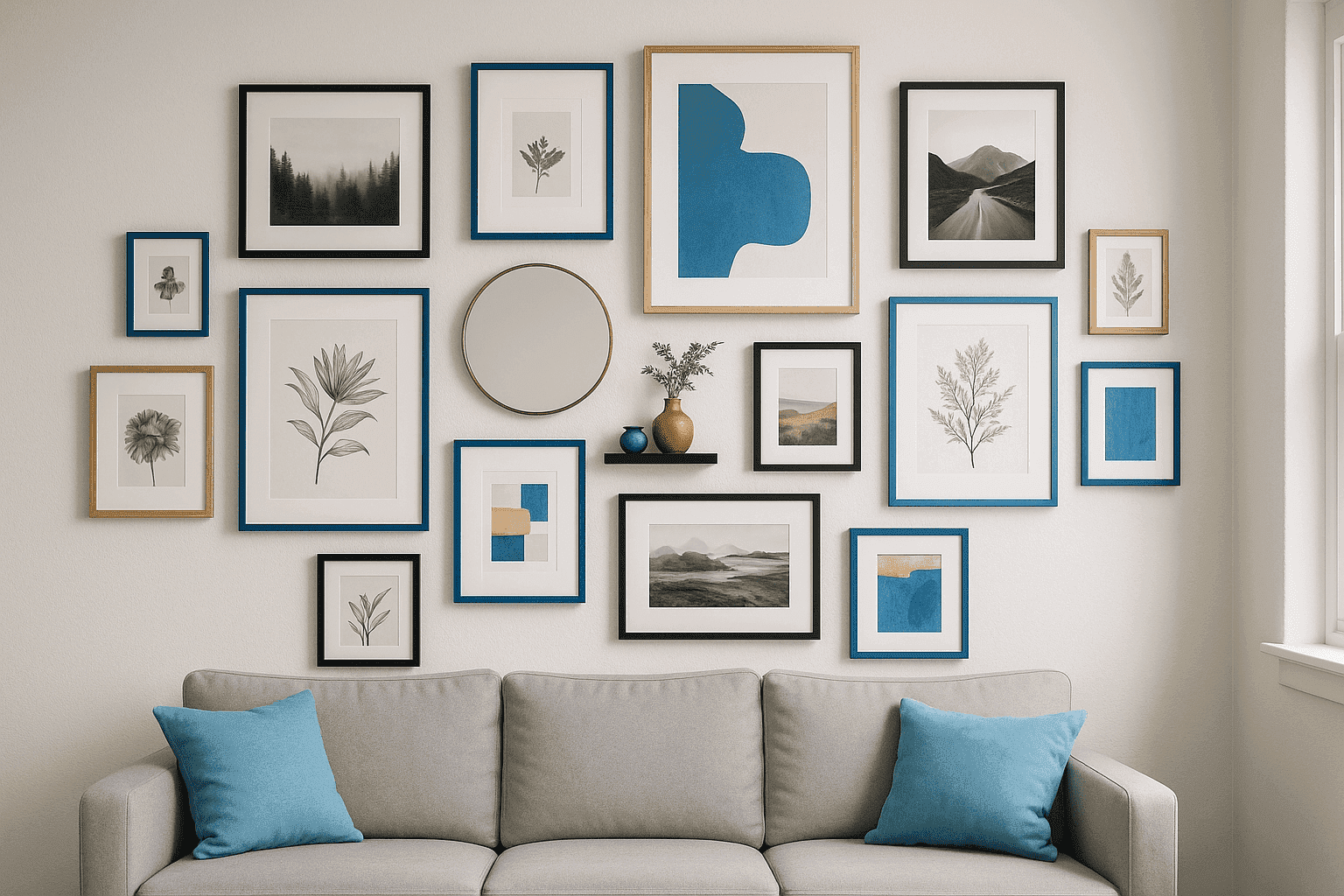
Gallery walls transform blank spaces into personalized showcases of your style, interests, and memories. Unlike single large artworks, these curated collections create visual interest through contrast, connection, and conversation between varied pieces. The beauty of a gallery wall lies in its ability to evolve over time, accommodating new treasures while maintaining cohesion through thoughtful arrangement and common elements.
What You'll Need
| Assorted artwork and frames |
| Kraft paper or wrapping paper |
| Scissors and pencil |
| Painter's tape |
| Level |
| Measuring tape |
| Hammer and nails |
| Picture hanging hardware |
| Wall anchors (for heavier items) |
| Wall patch kit (for fixing mistakes) |
| Non-traditional items (optional): |
| • Small mirrors |
| • Wall sculptures or 3D objects |
| • Small shelves for dimensional items |
How To Create It
- Curate your collection - Gather artwork, photographs, and objects that share a common element—color palette, subject matter, frame style, or theme. Aim for variety in sizes, orientations, and textures.
- Choose your layout style - Consider these popular arrangements:
- Grid - Formal arrangement of same-sized frames
- Salon - Organic, densely packed arrangement
- Linear - Aligned along horizontal or vertical axis
- Centered - Building outward from a focal piece
- Arrange on the floor first - Experiment with different layouts on the floor or a large table. Start with your largest piece positioned off-center, then build around it.
- Create paper templates - Trace each framed piece onto kraft paper and cut out. Mark where hanging hardware is located on each template.
- Test on the wall - Using painter's tape, position your paper templates on the wall. Step back frequently to assess the arrangement. Ideal height is with the center of the arrangement at eye level (approximately 57-60 inches from the floor).
- Maintain consistent spacing - Keep 2-3 inches between frames for balance—too close looks cluttered, too far apart loses cohesion. Spacing can be uniform or varied based on your style.
- Mark hardware positions - Once satisfied with your arrangement, mark where each hanging element (nail, hook) should go directly on the templates.
- Install hardware - Hammer nails or install wall anchors and screws through the marks on your templates, then tear away the paper.
- Hang with precision - Hang each piece in its designated spot, using a level to ensure everything is straight.
- Make final adjustments - Step back and assess the overall composition, making minor adjustments as needed. Don't be afraid to leave room for future additions.
Gallery Wall Styles
- Symmetrical - Formal and balanced, ideal for traditional spaces
- Eclectic - Mix of mediums, frames, and subjects for a collected-over-time look
- Monochromatic - Unified color scheme creates elegance despite varied content
- Themed - Collection showcasing a specific interest (botanicals, travel, family)
- Floor-to-ceiling - Dramatic statement for hallways or stairwells
For gallery walls that truly shine, consider creating a focal point by positioning your most significant or colorful piece slightly off-center at eye level, then building outward. To avoid a haphazard look, maintain at least one consistent element across all pieces—whether it's frame color, mat width, or subject matter. When incorporating non-traditional items like small mirrors or dimensional objects, position these thoughtfully within the composition rather than at the edges. Finally, for extending gallery walls around corners, treat each wall as a separate but related composition with its own visual center, while maintaining the same spacing and style throughout both surfaces.