Mount a Door Spice Rack in 1 Hour for $25
Reclaim an entire shelf by moving your spices to the one place nobody's using
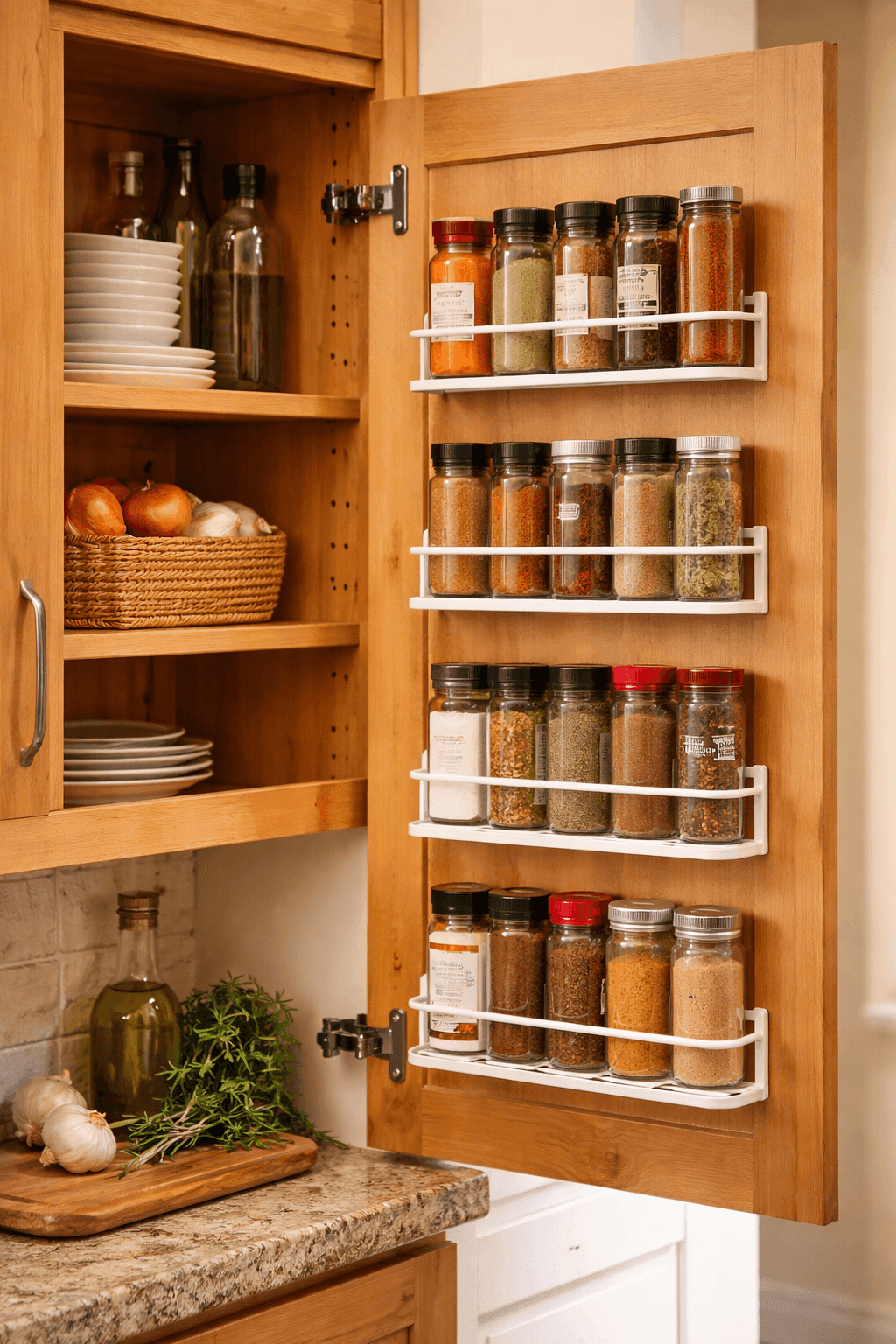
If you've ever knocked over four spice jars trying to reach the cumin hiding behind them, you already know the inner cabinet door is the most underused real estate in your entire kitchen. That flat vertical surface sits empty every single day while your spices eat up precious shelf space in a chaotic single-file pile nobody can see into. Mounting small shelves or a magnetic strip on the inside of a cabinet door takes about an hour and costs $20–30, and the payoff is immediate — every spice you own becomes visible, grabbable, and back where it belongs in two seconds flat. This is one of those kitchen upgrades that reorganizes an entire area of your cooking life without changing a single thing about your kitchen's exterior appearance. Renters love it, small kitchen owners need it, and anyone who cooks more than twice a week will wonder how they ever managed without it.
What You'll Need
- Choose Your Storage Method
- Over-door spice rack with pre-built narrow shelves – easiest option, no measuring required (~$18–25 on Amazon or at home goods stores)
- Magnetic spice tins with adhesive magnetic strip – sleek, modern look, works beautifully on metal doors or with a strip mount (~$15–22 for a starter set)
- DIY narrow wooden shelves cut to door width – most customizable option, requires a saw and screws (~$12–18 in lumber and hardware)
- Hardware & Tools
- Drill with a Phillips bit (or a manual screwdriver for lighter shelf systems)
- 1-inch wood screws – short enough not to poke through the door face
- Measuring tape and pencil
- Level – a small 6-inch bubble level is plenty for this job
- Painter's tape for marking shelf positions before committing
- Optional Extras
- Uniform spice jars with labels for a clean, cohesive look (~$10–15 for a set of 20)
- Adhesive foam bumpers to prevent shelves from rattling when the door closes
- Total Cost
- $20–30 for shelves or magnetic strip system; up to $45 if you add uniform jars and labels
How to Install It
- Measure the inner door panel carefully before buying anything — width, height, and the depth clearance between the closed door and the nearest shelf inside the cabinet. This last measurement is the critical one: you need at least 2.5–3 inches of clearance so your spice rack doesn't hit the shelf and prevent the door from closing.
- Empty the cabinet shelf that currently holds your spices and set everything on the counter — this gives you a clear view of what you own, lets you toss expired jars guilt-free, and gives you a realistic count of how many spices you actually need to fit on the door.
- Plan your shelf positions using painter's tape on the door before drilling anything. Hold each shelf or strip up to the door, mark the top and bottom edges with tape, and close the door to verify clearance. Adjust the tape marks until everything fits without catching.
- Mark your screw hole positions with a pencil while the tape is in place, then use a level to confirm each shelf position is perfectly horizontal — even a slight tilt will send jars sliding every time the door swings open.
- Drill pilot holes at each marked point using a bit slightly thinner than your screws — this prevents the door panel from splitting, especially on hollow-core or thinner cabinet doors. Keep your drill straight and don't go deeper than the door thickness.
- Mount each shelf bracket or magnetic strip, driving screws firmly but not overtightening — snug is enough, and over-tightening can crack a thin door panel or strip the hole. For magnetic strips, follow manufacturer instructions and allow adhesive to cure fully before loading jars.
- Test the door through its full open-and-close cycle before loading any spices. Open slowly, close firmly, and listen for any contact between the rack and the interior shelf. If anything catches, loosen and shift the bracket position by a half-inch before redriving the screws.
- Load your spices heaviest to lightest from bottom shelf to top — this keeps the door balanced and reduces stress on the upper brackets over time. Stick foam bumpers to the back of each shelf if you notice any rattling when the door closes.
Kitchen designers who spec out spice storage almost always recommend decanting into uniform jars rather than keeping the mismatched manufacturer bottles — not just for aesthetics, but because standard-sized jars stack and sit more predictably on narrow shelves and are far less likely to tip. The real upgrade move is labeling the lids rather than the sides, so when you're looking down into a shelf from above while cooking, you can read every single spice at a glance without pulling anything out. A set of 20 uniform 4-oz glass jars with printed or hand-labeled lids costs about $12–15 and completely transforms the door from functional to genuinely satisfying to open.